
 Save $709.19
Front-Loading Kilns
Compare kilns by craft, chamber size, and the power available in your studio.
Save $709.19 Save $3,627.38
 Save $3,142.25
 Save $2,239.77
 Save $3,107.36
 Save $1,135.35
 Save $925.60
 Save $831.94
 Save $745.52
 Save $181.50
 Save $209.00
 Save $321.80
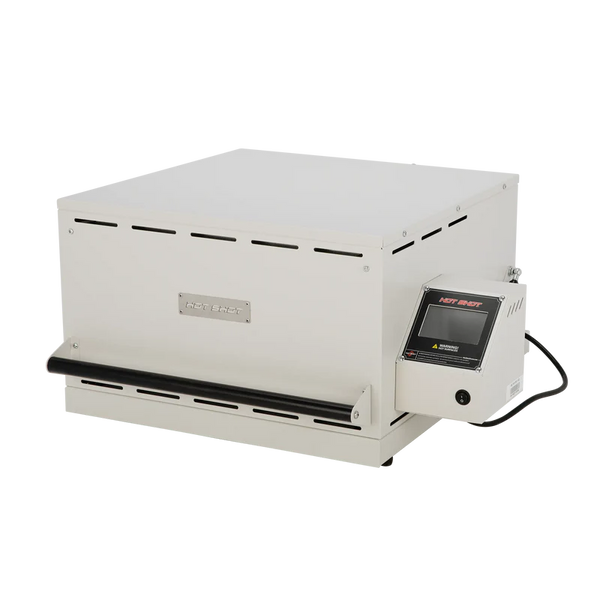 Save $149.49
 Save $644.60
 Save $92.34
 Save $98.83
 Save $98.83
 Save $272.50
 Save $150.64
 Save $263.89
 Save $950.90
 Save $1,158.90
 Save $686.65
 Save $680.05
Front-Loading Kilns
Front-Loading Kilns For Sale
Kilns and ovens that load through a door at waist height. HotShot, Olympic and Paragon, from a bench-top tempering oven at $1,288 to a 12 cubic foot production kiln.
33Front Loaders
4.5 inThickest Brick
$1,288Starting Price
Buying Guide
A door is not the same as thick walls
Front loading solves a real problem. You slide shelves in at waist height instead of leaning down into a hot chamber, which matters enormously if you load every day, if several people share the kiln, or if reaching into a deep top loader is not comfortable for you.
What it does not automatically mean is a better-insulated kiln, and that is where the money actually goes. Olympic's FL series carries 4.5 inches of brick plus an inch of fiber. Their 1818FLE, also a front loader, carries 2.5 inches, the same as a typical top loader. Both load through a door. Only one is built for continuous high-fire work, and they are nowhere near the same price.
Thirty-three front loaders here, covering pottery, glass and heat treating. If the door is not what you need, the top-loading range gives you more chamber for the money.

Why buy your kiln from us
Authorized dealer for every brand on this page, which is what keeps your warranty valid.
We will tell you what the extra cost buys
Front loading carries a real premium per cubic foot. Sometimes it is clearly worth it and sometimes it is not, and we would rather explain which before you order than after.
Shipping quoted up front
Discounted flat-rate shipping calculated at checkout before you buy, with no surprise charges afterwards. The large front loaders move by freight with liftgate service where the delivery requires it.
Price match guarantee
Find the same kiln advertised for less by an authorized dealer and we will match it. Details on our price match page. No sales tax outside Georgia.
Test firing does not void returns
The manufacturer's recommended initial test firing will not automatically void a return, provided the remaining conditions are met. Read the full terms on our returns page.
Shop front loaders by what they are for
Front loading spans three quite different kinds of machine here, and they have very little in common beyond the door.
Bench
Small format, $1,288 to $1,852
HotShot clam shell ovens and kilns that sit on a bench and run off a household circuit. Heat treating, tempering and glass.
Shop bench-topMid
Workshop, $2,222 to $2,945
Larger chambers on 240V. Knife ovens, the larger HotShot units and Olympic's entry front loader for pottery.
Shop workshop sizeLarge
Production pottery, $6,313 to $11,727
Olympic's FL series. Four and a half to seventeen cubic feet, 4.5 inches of brick plus fiber, and a car floor on some models.
Shop productionREAD
THE
BRICK
THE
BRICK
Two front loaders, the same door, four times the price per cubic foot
The Olympic 1818FLE is a front-loading pottery kiln at $2,234. It holds 1.95 cubic feet, is rated cone 8, and has 2.5 inches of brick, exactly what a typical top loader has. The Olympic FL4.5E is also a front-loading pottery kiln, at $6,313. It holds 4.5 cubic feet, is rated cone 10, and has 4.5 inches of brick plus an inch of fiber.
Per cubic foot that is roughly $1,146 against $1,403, which does not sound dramatic until you notice the FL4.5E also weighs 740 pounds against 195 and reaches two cones higher. You are not paying for the door. You are paying for the wall thickness that lets the kiln hold cone 10 repeatedly without cooking itself.
So read the brick spec, not the format. If you want waist-height loading on a budget and fire to cone 6, the lighter front loader is a sensible buy. If you are firing cone 10 week in and week out, the heavy insulation is the whole point. Call (470) 264-3563 and tell us which you are.
Still narrowing it down?
These collections slice the same catalog a different way.
Related collections
If none of these 33 is quite right, start here instead.
Top-Loading Kilns
More chamber for the money, if you can live with reaching down into it.
Heat Treating Ovens
Hardening and tempering ovens, most of which are front-loading clam shells.
Ceramic Kilns
All 65 pottery kilns, sorted by chamber size rather than by format.
Glass Kilns
Fusing and slumping, including the HotShot clam shell glass kilns.
Front-loading kiln FAQs
The questions we get asked on the phone most often.
Why do front loaders cost more?
Two reasons, and only one of them is the door. A front-loading kiln needs a structure strong enough to carry an insulated door and a seal that survives thousands of cycles at high temperature, which is genuinely more engineering than a lid.
The bigger reason is that most front loaders in the pottery range are also built much heavier. Olympic's FL series carries 4.5 inches of brick plus an inch of fiber, and that insulation is most of the weight and most of the cost.
Is front loading better for my back?
Usually, yes, and that is often the whole reason to buy one. You slide shelves in horizontally at roughly waist height rather than lowering them down past a hot rim into a chamber that may be 27 inches deep.
It is a particularly strong argument for teaching studios and shared spaces, where lots of different people load the kiln and not all of them can comfortably lean into a deep top loader.
What is a car kiln?
One where the floor rolls out on rails rather than staying put. You load the whole floor outside the kiln at a comfortable height, then push it in.
It is the most ergonomic arrangement there is and the most expensive. Olympic offers car versions of several FL models, and they are aimed at studios loading large or heavy work regularly.
How thick should the brick be?
It depends on how hard you fire. Two and a half inches is standard on top loaders and on lighter front loaders like Olympic's 1818FLE, and it is adequate for cone 6 work.
Four and a half inches plus fiber, as on Olympic's FL series, is what lets a kiln hold cone 10 repeatedly without punishing its own elements and shell. It also holds heat longer, which cuts the power cost of a firing.
Do front loaders fire evenly?
They tend to be good at it, because the heat is contained by heavier walls and the chamber is usually squarer than a deep round top loader. Large models often have multiple heat zones as well.
As with any kiln, witness cones on the top and bottom shelves are the way to find out what yours actually does rather than what the brochure says.
Are all these pottery kilns?
No, and it is worth knowing before you browse. Front loading is a format rather than a craft, so this collection mixes three quite different things: HotShot's clam shell heat treating and glass units, knife ovens, and Olympic's FL series of production pottery kilns.
If you specifically want pottery, filter to the Olympic models or start from the ceramic kiln range instead.
What electrical supply will I need?
It ranges further than on any other page here. A HotShot HS-360T runs on an ordinary 120V, 15 amp circuit. An Olympic 1818FLE draws 21 amps on 240V and wants a 30 amp breaker on a NEMA 6-30.
The production kilns are another matter: an FL4.5E draws 36 amps and wants 50, an FL8E draws 48 and wants 60, and an FL12E draws 56 and wants 70. Have an electrician confirm your panel before ordering.
How much room does the door need?
More than people allow for. The door swings out to its full width, so you need that clearance in front of the kiln plus room to stand and maneuver a loaded shelf.
Measure the swing as well as the footprint before you commit to a position, especially in a garage or a narrow studio. We can give you the figures for a specific model.
How are they delivered?
The bench-top HotShot units often ship by parcel carrier. The Olympic FL series does not: an FL4.5E is 740 pounds, an FL8E is 1,065 and an FL12E is 1,165. Those move by freight with curbside delivery, appointment scheduling, tracking and liftgate service where required.
Unlike a sectional top loader, a front loader arrives in one piece, so the route from the curb into the studio needs checking carefully. Shipping is calculated at checkout. See our shipping page.
Can I return a kiln after a test firing?
Performing the manufacturer's recommended initial test firing will not by itself void a return, as long as the other conditions in our policy are met.
Read the full terms, including timeframes and condition requirements, on our returns page.
Eleven front loaders, bench to production
Brick thickness is listed wherever the manufacturer publishes it, because it is the spec that separates these.
Bench top, household circuit

Hot Shot HS-360T
- 10 D x 6 W x 6 H in, 0.21 cu ft
- 600F max, tempering and annealing
- 120V, 15A circuit
- Front-loading clam shell
$1,288$1,997
View Details

Hot Shot HS-7G
- 7 D x 7 W x 7 H in chamber
- 1850F max
- 120V
- Front-loading clam shell
$1,511$1,679
View Details

Hot Shot HS-360K
- 10 D x 6 W x 6 H in, 0.21 cu ft
- 2200F max
- 120V or 240V, specify at order
- Tap&Go controller, solid state relay
$1,687$2,458
View Details

Hot Shot HS-12G
- 12 x 12 x 6 in chamber
- 1700F max
- 120V, 15A
- Front-opening clam shell
$1,852$2,088
View Details
Workshop, 240V

Olympic 1818FLE
- 17.5 x 18 x 12 in, 1.95 cu ft
- Cone 8, 2300F
- 240V, 21A, 30A breaker, NEMA 6-30
- 2.5 in brick, 195 lb
$2,234$3,100
View Details

Hot Shot HS-1200
- 12 D x 10 W x 10 H in, 0.69 cu ft
- 2000F max
- 240V, 20A, NEMA 6-20
- Tap&Go controller, solid state relay
$2,222$3,284
View Details

Hot Shot HS-18K
- 18 D x 6.5 W x 4.5 H in
- 2200F max
- 120V at 15A, or 240V at 20A
- Front-loading clam shell
$2,222$3,492
View Details

Hot Shot HS-24K
- 24 D x 8 W x 7 H in
- 2200F max
- 240V at 20A
- Front-loading clam shell
$2,945$4,100
View Details
Production pottery, Olympic FL series

Olympic FL4.5E
- 18 x 18 x 24 in, 4.5 cu ft
- Cone 10, 2350F
- 240V, 36A, 8640W, 50A breaker
- 4.5 in brick plus 1 in fiber, 740 lb
$6,313
View Details

Olympic FL8E
- 24 x 24 x 24 in, 8 cu ft
- Cone 10, 2350F
- 240V, 48A, 60A breaker
- 4.5 in brick plus 1 in fiber, 1,065 lb
$8,358
View Details
Olympic FL12E
- 24 x 24 x 36 in, 12 cu ft
- Cone 10, 2350F
- 240V, 56A, 70A breaker
- 4.5 in brick plus 1 in fiber, 1,165 lb
$9,696
View Details