

Thermocouples
Type K by gauge and probe length, with blocks and lead wire. The usual reason a kiln reads wrong.
Thermocouples
If the kiln is reading wrong, this is usually why
A thermocouple is the kiln's only sense of how hot it is. They drift as they age, and a drifting thermocouple does not announce itself — it just quietly starts under-firing or over-firing everything you load.
2Brands
6Cress Probe Lengths
8Evenheat Types
Buying Guide
Thermocouples drift before they fail
A Type K thermocouple works by producing a tiny voltage across a junction of two dissimilar metals. That junction sits in the chamber, cycling to cone temperature and back, and over hundreds of firings the metals degrade. The voltage shifts, and so does the temperature the controller thinks it is seeing.
The symptom is not an error message. It is cone packs that stop matching the controller, glazes that come out a little under, or a kiln that suddenly seems to fire hotter than it used to. If the kiln is reading wrong and nothing else has changed, suspect the thermocouple first and the controller second.
A thermocouple is a cheap part and it is the single most common cause of a kiln that will not hold its numbers. Potters firing production schedules often replace them on a calendar rather than waiting for the symptom.

Why buy your thermocouple from us
Authorized Cress and Evenheat dealer.
We confirm the part against your serial
Send us the model and serial from the kiln's plate and we will tell you exactly which part it takes before you order.
Gauge and length both matter
A thermocouple has to match the gauge, the probe length and the mount the kiln uses. Tell us the model and we will identify it rather than letting you guess from a photograph.
Flat $19 shipping per order
One flat rate anywhere in the US however many items are in the cart, so it is worth ordering spares at the same time.
Price match guarantee
Find the same part advertised for less by an authorized dealer and we will match it. Details on our price match page. No sales tax outside Georgia.
What we stock
All Type K. The differences are gauge, probe length, insulator size and mount.
| Brand | What you can buy |
|---|---|
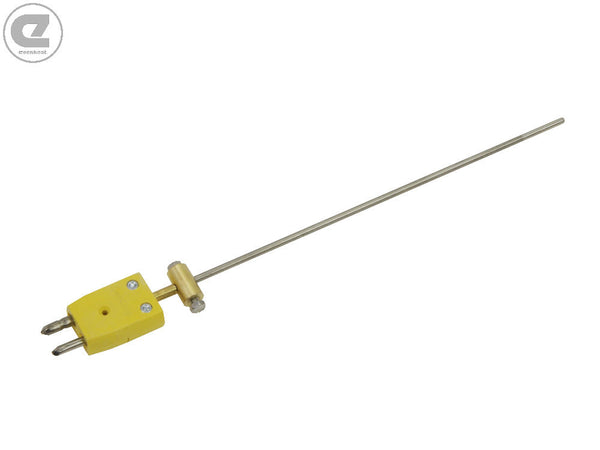
| Cress | Type K thermocouple with block in 3″, 5″, 7″, 8″, 10″ and 12″ probe lengths, plus a 4 ft lead wire with connectors. The block is part of the assembly, so the probe arrives ready to mount. |
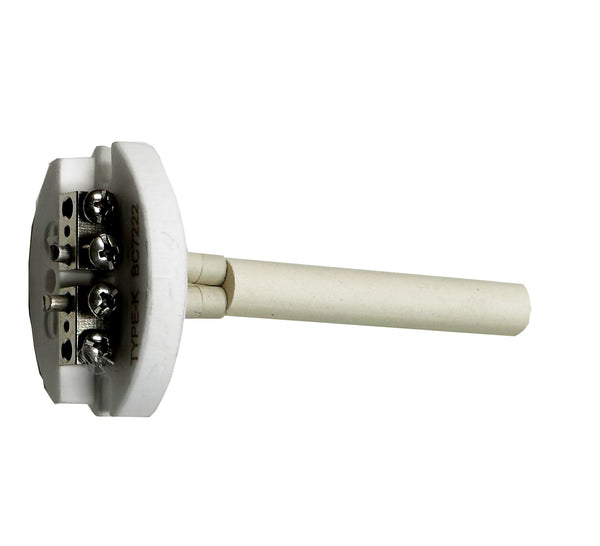
| Evenheat, standard | Type K in 8 gauge at 4″ and 5″ long, 14 gauge at 4″ with either ½″ or 5/16″ insulators, 16 gauge at 3″, and 20 gauge at 4″ with 5/16″ insulators. |
| Evenheat, sheathed | 1/8″ sheath thermocouples bent for the Super and Standard controls, and a different bend for the Deluxe. |
| Evenheat, salt bath | Chamber and immersion thermocouples for the Salt Bath 709, 718 and 818, their lead sets, the immersion mount, and the separate over-temperature thermocouple. |
| Lead wire and blocks | Cress lead wire with connectors, and the Evenheat thermocouple terminal block, both sold separately for when the probe is fine and the connection is not. |
Insulator size is not a detail. A 14 gauge Evenheat thermocouple comes with either ½″ or 5/16″ insulators and they are not interchangeable in the mount. Check before ordering.
READS
WRONG
The order to suspect things in
If the kiln is firing to the wrong temperature, the thermocouple is the first thing to check, because it is the part that measures and the part that ages fastest.
Second is the connection: a lead wire with a loose or corroded connector produces exactly the same symptom as a tired probe, and costs less to fix.
Third is the control itself. A controller that has lost calibration or a board that is failing will also misread, but it is the least likely of the three. Call us and describe what the cone packs are doing — (470) 264-3563.
The rest of the measuring and control chain
A reading is only as good as the parts carrying it.
Related collections
Other ways into the same catalogue.
Kiln thermocouple FAQs
The questions we get asked on the phone most often.
How do I know my thermocouple has gone?
Usually because the kiln stops matching cone packs. The controller says one thing and the cones say another, and the gap grows over a few firings.
Thermocouples drift rather than fail outright, so there is rarely an error message. If the numbers have moved and nothing else has changed, start here.
How often should a thermocouple be replaced?
There is no fixed interval, because it depends on how hot and how often you fire. A hobby potter firing low-fire occasionally may go years. Someone firing cone 6 glaze several times a week will see drift much sooner.
Studios on production schedules often replace them on a calendar rather than waiting for the symptom, because the cost of a bad firing is higher than the cost of the part.
What is Type K?
The thermocouple type used in nearly all pottery and glass kilns, named for the particular pair of metals in the junction. Every thermocouple on this page is Type K.
Type matters because the controller is calibrated to expect a specific voltage curve. Fitting a different type would misread badly.
What is the difference between gauge and probe length?
Gauge is the thickness of the wire — a lower number is thicker. A thicker thermocouple lasts longer and responds a little more slowly; a thinner one responds faster and wears out sooner.
Probe length is how far the junction reaches into the chamber. Both are set by the kiln, not by preference.
Can I fit a thermocouple myself?
It is one of the more approachable kiln repairs, since on most kilns the probe comes out from the outside and the connection is two screws. The kiln still has to be isolated at the breaker first.
Polarity matters on the connection. If you reverse it the reading goes the wrong way, which is confusing but not damaging.
How is it shipped?
Flat $19 per order anywhere in the US, however many items are in the cart. Everything on this page qualifies. Full terms on our shipping page.