
Kiln Sitter Parts
All eleven pieces of the Cress mechanism, individually. Nothing in it is a sealed unit.
Kiln Sitter Parts
A mechanism simple enough to keep running indefinitely
The Kiln Sitter shuts a manual kiln off when a small pyrometric bar bends. There is nothing electronic about it, which is why kilns built decades ago are still firing — every part of it can be replaced individually.
11Replaceable Parts
4Tube Lengths
$19Flat Shipping
Buying Guide
How a Kiln Sitter actually works
A small pyrometric bar sits in the chamber, resting on two cone supports with a metal claw laid across the middle of it. As the kiln reaches temperature the bar softens and sags. The claw drops with it, that movement travels out of the chamber along a sensing rod inside a tube assembly, and at the outside end it trips a switch block that cuts power to the elements.
That is the whole device. No sensor, no board, no firmware. It fires by the behaviour of a piece of clay, which is why it has outlived several generations of electronics, and why a kiln from the 1970s with a working Sitter is still a usable kiln.
When one stops working, the fault is almost always mechanical and almost always in one identifiable piece: the tube binding, the claw worn or bent, the switch block tired, or the motor on a FireMate timer stopped. Each of those is a part, not a kiln.

Why buy your Kiln Sitter parts from us
Authorized Cress dealer.
We confirm the part against your serial
Send us the model and serial from the kiln's plate and we will tell you exactly which part it takes before you order.
Describe the symptom, we will name the part
Will not shut off, will not stay up, claw not dropping, timer dead — each of those points at a different part. Tell us what it is doing and we will tell you which one to order.
Flat $19 shipping per order
One flat rate anywhere in the US however many items are in the cart, so it is worth ordering spares at the same time.
Price match guarantee
Find the same part advertised for less by an authorized dealer and we will match it. Details on our price match page. No sales tax outside Georgia.
Which part is it?
Symptom on the left, part on the right.
| Symptom | The part |
|---|---|
| Kiln will not shut off | Switch block assembly with plunger, or a sensing rod that is binding inside the tube. The claw may also have worn enough that it no longer travels far enough to trip the block. |
| Will not stay set | Claw and set screw. A worn claw or a set screw that no longer grips lets the mechanism fall back before the firing starts. |
| Bar bends but nothing happens | Sensing rod, or the tube assembly it runs in. If the rod cannot move freely the sag never reaches the switch. |
| Timer does not run | Timer motor, in 240 volt or 120 volt — check the plate on the kiln before ordering, they are not interchangeable. |
| Bar sits wrong, or will not sit | Cone supports, which hold the bar at the correct height and angle, or the firing gauge washer that sets the drop distance. |
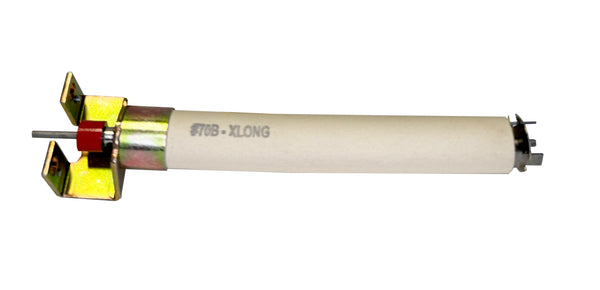
| Tube is the wrong length | Tube assemblies come for 4″ or 4½″, 6″ and 7″ walls, plus a long version for 2½″ thick walls. The length is set by the wall, not by choice. |
Voltage on the timer motor. 240 volt and 120 volt motors look alike and fitting the wrong one will not work. Read it off the plate rather than from memory.
ONE
PART
Do not replace the mechanism to fix one piece of it
Because the Sitter is simple, the temptation when it misbehaves is to swap the whole assembly. That is almost never necessary. Eleven separate parts are available, and a Sitter that is not shutting off is usually one of them.
Before ordering anything, check that the sensing rod moves freely by hand with the kiln cold and off. A rod binding in a dirty tube accounts for a surprising share of calls.
If you are not sure which part you are looking at, photograph the mechanism and call us on (470) 264-3563.
Around the Sitter
The Sitter is one way of ending a firing. These are the others.
Related collections
Other ways into the same catalogue.
Kiln Sitter FAQs
The questions we get asked on the phone most often.
My kiln will not shut off. Is it the Sitter?
Usually, and usually in one of two places: the switch block assembly at the outside end, or a sensing rod binding in its tube so the claw's movement never reaches the switch.
With the kiln cold and isolated at the breaker, move the rod by hand. If it does not travel freely, that is your answer before you order anything.
Is a Kiln Sitter the same as a controller?
No. A Sitter is mechanical: a bar sags, a claw drops, a switch trips. A controller is electronic and follows a programmed ramp using a thermocouple reading.
Many manual kilns have a Sitter and nothing else. If you want programmable firings on such a kiln, a remote controller is the usual route — see Controllers & Boards.
Which tube assembly length do I need?
It is set by the thickness of the kiln wall, not by preference. Options are 4″ or 4½″, 6″, 7″, and a long version for 2½″ thick walls.
Measure the wall, or send us the model and serial and we will confirm it.
Do I need the 240 volt or the 120 volt timer motor?
Whichever the kiln is. They look alike and are not interchangeable, and the voltage is printed on the plate on the kiln.
If the plate is unreadable, give us the serial number.
How is it shipped?
Flat $19 per order anywhere in the US, however many parts are in the cart. Everything on this page qualifies. Full terms on our shipping page.