
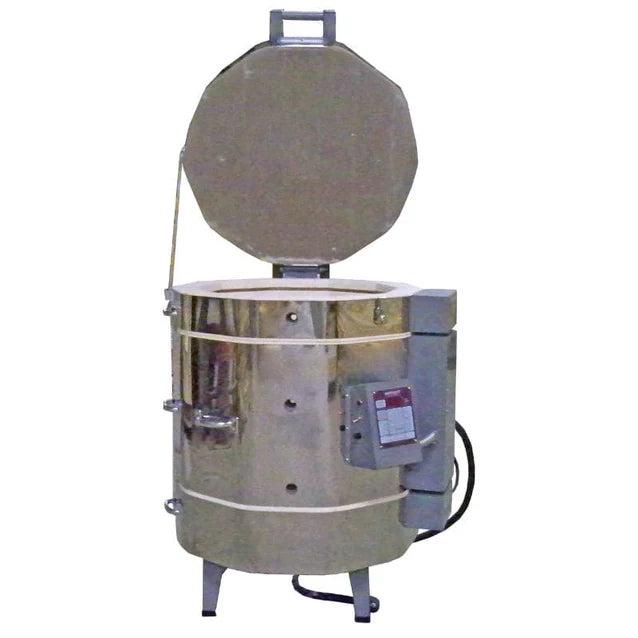
Kiln Electrical Requirements: Breaker, Wire & Outlet Guide (2026)
Almost every kiln we sell is bought before anyone looks at the breaker panel. That is the wrong order, and it is the single most common reason a kiln sits in a garage for three weeks after it arrives.

This guide covers what a kiln actually needs from your electrical system: how breakers get sized, which plug is which, what each manufacturer does and does not publish, and the specific traps that catch first-time buyers.
This is not a substitute for a licensed electrician. Every manufacturer we carry says the same thing, and so do we. The numbers below are a starting point for a conversation with someone licensed in your jurisdiction, not an installation plan.
Quick answer
The short version, before any of the detail.
- Your kiln needs its own dedicated circuit. Not shared with the lights, not shared with an outlet strip.
- The breaker is bigger than the kiln's amps, usually by 25%. A 48-amp kiln typically calls for a 60-amp breaker. That is not a safety margin someone invented; it is how continuous loads are sized.
- Your dryer outlet is almost certainly not enough. A dryer circuit is 30 amps. A full-size ceramic kiln draws 45 to 50.
- The plug on the cord does not tell you the circuit is right. The same NEMA 6-30 plug ships on Olympic kilns needing a 20-amp breaker and on others needing 30.
- Read the nameplate, not the listing. It reflects the voltage and phase your kiln was actually built with.
- Buying a 120V kiln sidesteps most of this. See our guide to the best 120V kilns. You give up size and top temperature, not much else. The cheapest route onto an ordinary household circuit in our catalog is the Olympic 1214-120E at $1,551.00, which draws 16 amps on a 20-amp circuit.
Start hereWhy the breaker is bigger than the kiln
A kiln is what the National Electrical Code calls a continuous load. Article 100 defines that as a load whose maximum current is expected to continue for three hours or more. A bisque firing runs eight to twelve. A glaze firing to cone 6 can run longer.
For continuous loads, two NEC sections work together. 210.19(A) requires branch-circuit conductors rated for at least 125% of the continuous load. 210.20(A) requires the same of the breaker or fuse. The practical effect, stated the other way round: a continuous load should not exceed 80% of the circuit's rating.
So the arithmetic for a 48-amp kiln runs like this:
- 48 amps full-load, drawn for more than three hours, so a continuous load
- 48 × 1.25 = 60 amps minimum breaker
- 60 amps is a standard breaker size, so no rounding up needed
- The conductors have to carry 60 amps too, which lands on 6 AWG copper in most installations
Note that the subsection lettering has shifted between NEC editions, and jurisdictions adopt different editions on different timelines. Cite the sections to your electrician and let them check against the edition your area enforces.
One place the manufacturers genuinely disagree
Olympic treats its kilns as continuous loads explicitly. Its operating manual states that "National Electrical Code requires breaker size to be 125% of load," and its published per-model breaker sizes are built on exactly that.
Evenheat takes a different view. Its own page for the High Fire 2327 argues that a kiln used for its intended purpose is not "continuous use," which it defines as full power on for three or more hours. The reasoning is that a kiln under thermostatic control cycles its elements rather than pulling full current the whole time.
Both positions are arguable. What matters for you is that the decision is not the kiln brochure's to make. It belongs to your electrician and your local inspector, who are the ones certifying the install. When the two readings differ, the conservative one costs you a slightly larger breaker and slightly heavier wire. The other direction costs considerably more.
ReferenceThe plug chart: which outlet is which
NEMA designations look cryptic but decode simply. The number after the dash is the amp rating, so a 6-50 is a 50-amp device. The number before it describes the configuration.
| NEMA | Volts | Amps | Ground? | What it looks like |
|---|---|---|---|---|
| 5-15 | 120 | 15 | Yes | The ordinary household plug |
| 5-20 | 120 | 20 | Yes | Like 5-15, but one blade is T-shaped |
| L5-30 | 120 | 30 | Yes | Curved blades you insert and twist to lock |
| 6-20 | 240 | 20 | Yes | Three prongs: two flat blades, one round pin |
| 6-30 | 240 | 30 | Yes | Three prongs, angled blades |
| 6-50 | 240 | 50 | Yes | Large three-prong. The classic welder outlet |
| 10-30 | 120/240 | 30 | No | Old three-prong dryer plug |
| 10-50 | 120/240 | 50 | No | Old three-prong range plug |
| 14-30 | 120/240 | 30 | Yes | Modern four-prong dryer |
| 14-50 | 120/240 | 50 | Yes | Modern four-prong range, RV or EV outlet |
| Direct wire | any | any | Yes | No plug. Conductors land in a box on the kiln |
Scroll the table sideways to see every column.
The 10-30 and 10-50 problem
Those two older configurations carry no separate equipment grounding conductor. They use the neutral to do double duty as the ground path. If that connection ever degrades, the appliance chassis can become energised.
The NEC does contain a grandfather provision allowing the neutral to serve as the ground on existing circuits, but it is written for a specific, closed list of appliances: ranges, wall-mounted ovens, counter-mounted cooking units and clothes dryers. A kiln is not on that list.
So the exception people reach for when they say "but my old dryer outlet is still legal" does not extend to hanging a kiln off it. If you have a three-prong 240V outlet in the garage, that is a conversation to have with an electrician before you order, not after.
DisclosureWhat each brand actually publishes
This varies far more than you would expect, and it determines how much homework lands on you. We checked every manufacturer we carry in October 2026.
| Brand | Amps | Plug type | Breaker size | Wire gauge |
|---|---|---|---|---|
| Olympic | Yes | Yes | Yes | Yes |
| Evenheat | Yes | Yes | No | No |
| Jen-Ken | Yes | Yes | Varies by line | Varies by line |
| HotShot | Yes | Partial | No | No |
| Cress | Yes | Yes | Fuse rating | Partial |
| Paragon | Yes | Yes | Varies | Varies |
Scroll the table sideways to see every column.
Olympic publishes the most by a wide margin. Volts, amps, watts, breaker size, copper wire gauge with a long-run adjustment, and the NEMA plug, per model, on the product page, plus a master amps-to-breaker-to-wire lookup chart in its operating manual. If you want the electrical question answered before you buy, Olympic makes it easiest.
Evenheat publishes volts, amps, watts, phase and plug configuration and then refers you out, with the same line on every model page: consult an electrician for the fuse panel, service wire size, receptacle and fusing requirements. That is a defensible position, but it does mean the breaker figure is yours to derive.
Jen-Ken's disclosure depends which line you are looking at. On the vertical air bath knife kilns, the specification table gives volts, amps, watts and plug and stops there. Their team is good on the phone about this, so call before you buy rather than inferring.
HotShot publishes the least. A combined amp and voltage figure and little else. For the 240V models, ask them directly for the plug and breaker before you plan the circuit.
Our catalogReal models, real numbers
Manufacturer-published electrical specifications, with our prices as of 30 October 2026, pulled live from our catalog. Freight is additional, see shipping.
| Kiln | Volts | Amps | Breaker | Copper wire | Plug | Our price |
|---|---|---|---|---|---|---|
| Olympic 1214-120E | 120 | 16 | 20A | #12 (#10 over 40 ft) | 5-20 | $1,551.00 |
| Olympic 1214-120HE | 120 | Not published | 30A | Not published | L5-30 | $1,655.00 |
| Olympic MAS1823HE | 240/208 | 26.25 / 30 | 40A | #8 (#6 over 40 ft) | 6-50 | $2,260.00 |
| Olympic 1823HE | 240/208 | 26.25 / 30 | 40A | #8 (#6 over 40 ft) | 6-50 | $2,647.00 |
| Olympic 2327HE | 240 | 47 | 60A | #6 (#4 over 40 ft) | 6-50 | $3,976.00 |
| Evenheat RM II 1813 | 240 | 18 | Not published | Not published | 6-20 | $2,136.00 |
| Evenheat HF 2327 | 240 | 48 | Not published | Not published | 6-50 | $4,297.00 |
| Jen-Ken Vertical Air Bath EDC | 120 | 15 | Not published | Not published | 5-15 | $1,505.00 |
Scroll the table sideways to see every column.
Two things to notice in that table
First, the Olympic 2327HE and the Evenheat HF 2327 are nearly the same kiln electrically, at 47 and 48 amps, both on a 6-50 plug. Olympic tells you it wants a 60-amp breaker and 6 AWG copper. Evenheat tells you to ask an electrician. Same circuit, different amount of homework.
Second, a 6-50 plug on a 48-amp kiln sits close to its limit. A 50-amp receptacle on a circuit sized for a continuous 48-amp load is exactly the situation where Olympic's own chart starts recommending direct wiring instead of a plug. If your kiln is 40 amps or more, ask your electrician whether to hardwire it. The cord's plug is not evidence that a receptacle is the right answer.
Watch outFive traps that catch people
1. The dryer outlet
A dryer circuit is 30 amps. A full-size ceramic kiln, the 2327HE at 47 amps or the HF 2327 at 48, would be asking those conductors to carry roughly 160% of their rating. And if the outlet is the older three-prong type, there is no equipment ground either. Two independent reasons it fails.
Dryer outlets do work for genuinely smaller kilns. Check the amps on the nameplate against the circuit, and do not match the plug shape.
2. "My outlet looks the same"
Same shape, different circuit is the rule rather than the exception. Olympic ships a 6-30 cord on a 13-amp kiln that needs only a 20-amp breaker, and on a 24-amp kiln that needs 30. A 10-50 and a 14-50 both look like big 240V outlets; one has a ground and one does not.
3. Long wire runs
Voltage drop is not primarily a safety issue. It is why your kiln will not reach temperature. Undervoltage does not trip anything. The kiln simply climbs more slowly, stalls short of cone, and the owner blames the elements.
Both Olympic and Skutt publish adjustments for this. Olympic bumps the wire one full gauge past 40 feet on every row of its chart: #12 to #10, #8 to #6, #6 to #4.
If your panel is on the other side of the house from your kiln, say so when you get the quote. Run length is the one variable an electrician cannot guess from the model number, and it is the one that decides whether you need the next gauge up.
4. Three-phase
Same kiln, same wattage, very different circuit. Olympic's 2327HE draws 47 amps single-phase at 240V, but only 31 amps three-phase, and the three-phase version is direct wired, with no power cord at all.
The catch: three-phase is a commercial service. It is essentially unavailable in US homes. Phase is also a factory build option, not something changed in the field. Order a three-phase kiln for a home studio and you have bought a kiln you cannot power.
5. Assuming the listing is right
Spec tables contain errors, including ours occasionally, and certainly those of dealers who copy them between sites. We have seen a kiln listed at "100 volts" with a plug type that has not been manufactured in decades. The nameplate on your kiln reflects what was actually built: the voltage option, the phase, the element configuration. It is the only document that describes your kiln.
PaperworkPermits and electricians
Two separate questions, and people conflate them.
Can you do the work yourself? Most states allow a homeowner to wire a residence they own and occupy. Commercial studios, rentals and schools generally fall outside that exemption.
Do you need a permit? Almost certainly yes, and this is the one people skip. Permit exemptions typically cover device swaps: replacing a switch, a fixture, a standard receptacle. Adding a new 240V circuit is new-circuit work, not a device swap, and that is permit territory nearly everywhere.
Call your local building department rather than relying on your state statute alone. Licensing tends to be statewide; permit practice is local and varies county to county. Two further points worth knowing: an issued permit is not a substitute for the final inspection, and uninspected DIY electrical work can affect your homeowner's insurance.
Send us the model and we will send back the spec
Tell us which kiln you are considering and we will send back the published electrical specification: amps, plug, and the breaker and wire gauge where the manufacturer publishes them. If they do not publish it, we will tell you that rather than guessing, and we will call the factory if it matters.
Your situationWhich kiln should you buy for your electrical situation?

You have a standard household outlet and do not want to touch the panel
A 120V kiln. The Olympic 1214-120E at $1,551.00 draws 16 amps and runs on a 20-amp circuit, still a dedicated one, but ordinary residential work. See Best 120V Kilns for the trade-offs.
You have a 240V circuit already, an old welder or range outlet
Get the amps and breaker size first, then shop to that number. A 30-amp circuit opens up mid-size kilns, such as the Evenheat RM II 1813 at $2,136.00, which draws 18 amps. It does not reach a full-size 23-inch.
You are adding a circuit anyway and want to buy once
Size the circuit for the kiln you want in five years, not the one you are buying now. The marginal cost of running 6 AWG instead of 8 at install time is small. Running a second circuit later is not. Our guide to what size kiln you need is the right place to work out which kiln that is.
You are a school or a shared studio
You are in commercial territory: permits, inspection, and quite possibly three-phase available. That changes the calculation in your favour, because three-phase kilns draw substantially less current. See our guide to kilns for schools and classrooms.
You want the fewest unknowns
Olympic. Not because the kilns are better than Evenheat's or Paragon's, but because the breaker and wire gauge are printed on the product page, so your electrician can quote from a web page instead of a phone call. The Olympic 1823HE at $2,647.00 is the mid-size version of that argument: 26.25 amps at 240V, a published 40-amp breaker and a published #8 copper gauge.
Questions we getFrequently asked questions
What size breaker do I need for a kiln?
Generally 125% of the kiln's rated amps, rounded up to a standard breaker size. A 48-amp kiln takes a 60-amp breaker. Olympic publishes the figure per model; for other brands you or your electrician will calculate it from the amp rating on the nameplate.
Can I plug a kiln into a dryer outlet?
Only if the kiln draws comfortably less than the dryer circuit's 30-amp rating, and only if that outlet has a proper equipment ground. Full-size ceramic kilns draw 45 to 50 amps and cannot use a dryer circuit. Smaller kilns sometimes can. Check the nameplate amps, not the plug shape.
What wire gauge does a kiln need?
It follows from the breaker size, not the kiln's amps directly. A 60-amp circuit typically calls for 6 AWG copper. Runs over about 40 feet usually want one gauge heavier to limit voltage drop. Aluminium is not recommended for kiln circuits.
Does a kiln need its own circuit?
Yes. A dedicated circuit with nothing else on it. This is not a manufacturer preference. It is how a load this size is handled.
Why does my kiln not reach temperature?
If the kiln fires but stalls short of cone, voltage drop on a long or undersized run is a common cause, alongside worn elements. A kiln that has been fine for two years and is now slowing down is usually elements. A brand-new kiln that never reached temperature is usually the circuit.
Do I need an electrician, or can I do it myself?
Every manufacturer we carry says to use a licensed electrician, and so do we. Legally it varies: most states permit homeowners to wire their own residence, but a permit and inspection are required almost everywhere for a new circuit. Call your local building department.
Before you orderStill not sure what your kiln needs?
We are a family-owned kiln dealer in Georgia. Every kiln on this page ships flat-rate freight with liftgate service included, and we will match any authorized dealer's advertised price, see our price match guarantee. There is no sales tax on orders shipped outside Georgia. Veterans and first responders, check our military and first responder discount before you order.
Browse the full range in electric kilns, try the kiln finder, or just get in touch and ask. Send the model you are considering and we will come back with the published electrical specification, including the rows the manufacturer leaves blank.
Sources and scope. The electrical figures in this guide were read from published manufacturer sources in October 2026 and are reproduced as published: Olympic Kilns (1214-120E, 1214-120HE, MAS1823HE, 1823HE, 2327HE and the amps-to-breaker-to-wire chart in its operating manual), Evenheat Kiln (RM II 1813 and High Fire 2327) and Jen-Ken Kilns (Vertical Air Bath EDC). NEC references are to Article 100, 210.19(A) and 210.20(A). Where a manufacturer does not publish a breaker size or wire gauge, the table says so rather than estimating one. Prices are our own and were checked on 30 October 2026. These figures are recommendations, not an installation specification for your building. Codes, adopted NEC editions and permit rules vary by jurisdiction. Have a licensed electrician verify everything against your actual panel, run length and local code before any work is done.
Not sure your panel can take it?
Tell us the amps on your spare breaker space and the kiln you want, and we will tell you whether it fits before you pay for anything. No upsell, including when the answer is the smaller kiln.