
Buying a kiln for a school is not the same job as buying one for a home studio. The kiln has to survive thirty pairs of hands a week, fit a circuit the building already has, pass whatever your facilities department asks of it, and arrive inside a budget cycle that may have closed before the factory even starts building. The spec sheet matters less than you would think. The purchase order matters more.
This guide covers what actually decides the purchase in a teaching studio, which models fit which rooms, and how schools buy kilns without the process falling apart halfway through.
Quick picks
- No 240 V in the room: Cress ET911 — plugs into a standard household outlet, 0.55 cu ft, cone 6. $1,469.32.
- One art room, one teacher: Olympic MAS1823HE — 3.29 cu ft, cone 10. $2,336.88.
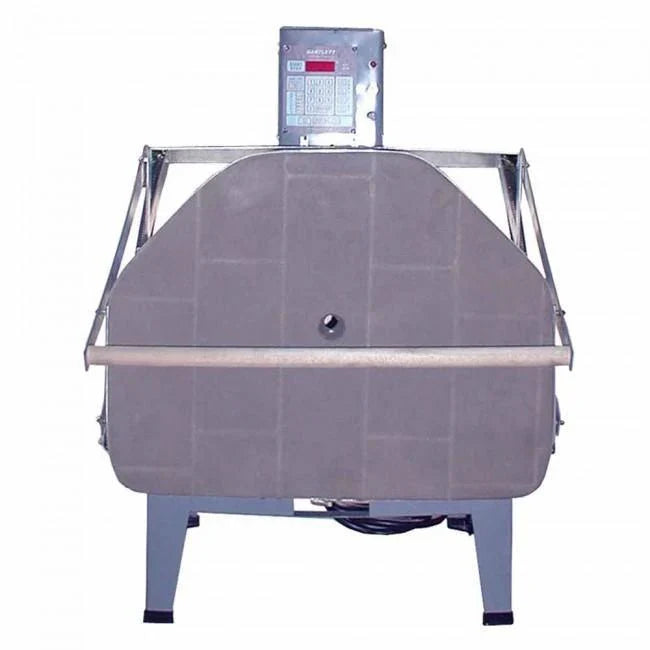
- The one that saves your staff's backs: Olympic 1818FLE — loads at waist height for $8.99 more than the equivalent top-loader. $2,390.81.
- Clay and glass in the same room: Jen-Ken Ceram-a-Glass 1815 — 1,700 °F glass and 2,150 °F ceramic in one chamber. $2,080.00.
- A department firing real volume: Olympic 2327HE — 7.0 cu ft, cone 10, on a 60 A circuit. $4,110.89.
All prices are ours as of October 2026.
Start with the panel, not the kiln
The single most common way a school kiln purchase goes wrong is that someone picks the kiln first and discovers the electrical bill afterwards. A kiln that needs a dedicated 60 amp 240 volt circuit in a building whose art room has two 120 volt outlets is not a $4,000 purchase. It is a $4,000 purchase plus an electrician, a conduit run, possibly a panel upgrade, and a facilities request that may take longer to approve than the kiln takes to build.
So find out what the room can supply before you shortlist anything. Three honest tiers:
A standard wall outlet. The Cress ET911 draws 15 amps at 120 volts and ships with an ordinary household plug. Cress asks for a 20 amp circuit with nothing else on it. That is it — no electrician, no conduit. The trade is size: 0.55 cu ft and cone 6, which fires bisque, low-fire and mid-range glazes but will not take you to cone 10. For an elementary classroom, a satellite room or a first kiln while funding is found for a bigger one, it does the job. Our full guide to 120 V kilns covers the rest of that range, and the 120 V collection lists all 82 of them.
A 30 to 40 amp 240 volt circuit. This is the sweet spot for most art rooms. It covers the 18-inch Olympic kilns and the Evenheat RM line, and it is a circuit most buildings can add without touching the main panel.
A 60 amp or larger 240 volt circuit. Now you are into real department capacity — 7 cu ft and up. Worth it if you are firing for several classes, but confirm the panel has the headroom before you quote it to your business office.
Our electrical requirements guide has the breaker and wire sizing per model, including the code rule that sizes the breaker at 125% of the kiln's draw. Send it to your electrician. One thing worth knowing from it: a kiln is not covered by the code exception that lets an old three-prong 240 V outlet skip a separate ground, so an existing dryer-style outlet in a shop room is probably not usable as-is.
The lineup, by what your room can supply
| Model | Format | Capacity | Max cone | Circuit | Our price, Oct 2026 |
|---|---|---|---|---|---|
| Cress ET911 | Top | 0.55 cu ft | 6 | 120 V, 20 A | $1,469.32 |
| Olympic Doll E / Test E | Top | Test size | 10 | 120 V | $1,396.51 |
| Evenheat RM II 1813 | Top | 2.0 cu ft | 8 | 240 V, 18 A draw | $2,188.19 |
| Olympic 1818HE | Top | 2.63 cu ft | 10 | 240 V, 30 A | $2,381.82 |
| Olympic 1818FLE | Front | 1.95 cu ft | 8 | 240 V, 30 A | $2,390.81 |
| Jen-Ken Ceram-a-Glass 1815 | Top | Clay and glass | 2,150 °F / 1,700 °F | See product page | $2,080.00 |
| Olympic MAS1823HE | Top | 3.29 cu ft | 10 | 240 V | $2,336.88 |
| Olympic 2327HE | Top | 7.0 cu ft | 10 | 240 V, 60 A | $4,110.89 |
| Olympic 2831HE | Top | 11.67 cu ft | 10 | 240 V, 80 A | $5,252.36 |
| Olympic FL4.5E | Front | 4.5 cu ft | 10 | 240 V, 50 A | $6,754.48 |
| Olympic FL12E | Front | 12.0 cu ft | 10 | 240 V, 70 A | $10,374.40 |
Not sure which capacity you need? Our kiln size guide works it out from what you actually fire rather than from square footage.
The $8.99 decision almost nobody makes on purpose
Here is the comparison that matters most in a teaching studio, and the one no manufacturer puts in front of you.
The Olympic 1818HE is a top-loader: 2.63 cu ft, cone 10, 30 amp circuit, $2,381.82.
The Olympic 1818FLE is a front-loader on the same 30 amp circuit: 1.95 cu ft, cone 8, $2,390.81.
Eight dollars and ninety-nine cents apart. Same circuit, same footprint in the room, and nothing in either listing tells you what you are trading.
What you give up with the front-loader is real: 26% less chamber volume and two cones of temperature. If your programme fires to cone 10, the FLE is simply out, and that ends the conversation.
What you gain is the thing schools underrate. A top-loading kiln is loaded by reaching down into a chamber that is 18 inches deep, repeatedly, often at the end of a day, frequently by the same one member of staff. A front-loader is loaded at waist height with the shelves in front of you. Across a school year, for a teacher loading and unloading several classes' work every week, that is a materially different physical task — and it is the kind of repetitive bending that turns into a workers' compensation claim rather than a complaint.
If your programme tops out at cone 6 — and most school ceramics programmes do, because mid-range glazes are where the good commercial glazes live — the front-loader costs you volume and nine dollars, and buys back a loading position your staff can sustain. That is a conversation worth having with whoever signs the requisition, because it is an argument about staffing, not about kilns. Our full top-loading versus front-loading comparison has the rest of the matched pairs, and the whole front-loading range runs to 55 models.
One caution before you commit: front-loaders are heavy. The FL4.5E ships at around 740 lbs and the FL12E at about 1,165 lbs, against 350 lbs for a 7 cu ft top-loader. Measure your doorways, your corridor turns and your floor rating before you order, and tell us about stairs when you ask for the quote so the freight is quoted correctly the first time.
One room, two media
Plenty of art departments teach ceramics and glass out of the same room with the same budget, and end up trying to fire both in a kiln designed for one. The Jen-Ken Ceram-a-Glass 1815 is built for exactly that case: 1,700 °F for glass and 2,150 °F for ceramics in the same chamber, at $2,080.00.
It is a genuine compromise rather than a trick — 2,150 °F does not reach cone 10, so a serious stoneware programme still wants a dedicated ceramic kiln. But for a department running a glass elective alongside intro ceramics, one kiln and one circuit instead of two is often the difference between the glass course happening and not happening. If glass is the larger half of what you teach, our glass fusing kiln guide and firing schedule guide are the better starting points, and the glass kiln range has 125 models.
Put the shelves on the same purchase order
This is the detail that most often turns into a second requisition and a six-week delay.
No kiln we sell ships with kiln furniture. Not one. Shelves, posts and kiln wash are priced separately by every manufacturer in our catalogue. The single exception anywhere is a one-quarter-inch fibre shelf with a couple of small Paragon models. A department that orders a kiln and nothing else takes delivery of a kiln it cannot fire.
For a school this is worse than it is for a home potter, because the second order usually means a second approval. Our Ready-to-Fire kits exist for this: the kiln and the matched furniture set as one line item, so the thing that arrives on your loading dock can be fired the week it lands. There are 35 of them, matched by chamber rather than by model number, which matters because shelf fitment does not follow the model name — an 18-inch octagon chamber takes a different shelf set from an 18-inch square one. Our guide to what actually comes with a kiln explains the fitment traps.
Worth adding to the same order while you are at it: a spare set of elements and a thermocouple. Elements are consumable, they always fail mid-term, and a school that has to raise a purchase order to get a kiln running again can lose weeks of class time. Our emergency parts kits are built per model for that reason.
Venting is not optional in a school
A kiln firing glazes puts out fumes. In a home studio people make their own judgements about that. In a building full of students, with a facilities department and an insurer, you should plan on a vent from the start — both for air quality and because it is the question your administration will ask.
Budget for it in the original quote rather than discovering it later. A downdraft vent system plus the receptacle to let the controller switch it on and off with the firing programme is a few hundred dollars on an order of this size, and retrofitting one after the kiln is installed against a wall is considerably less pleasant than specifying it up front.
How schools actually buy kilns
The mechanics trip up more orders than the specs do.
Purchase orders are fine. We accept them. You do not need a card, and you do not need to put a five-figure kiln on a departmental credit card to hold a price.
We will quote before your funding is approved. This is the one schools ask for most. You usually need a real written quote in hand to start the approval process — a quote is not a commitment, and we would rather give you an accurate one early than a guess. Request one through our commercial and bulk quotes page.
Educational pricing is set per programme, not as a fixed percentage. Tell us what you are buying and who you are, and we will price it. Details on the educational discount page — it covers K–12 schools and homeschool co-ops, colleges and universities, community art centres, libraries and makerspaces, camps and continuing education.
Tax. We do not collect sales tax outside Georgia. Georgia institutions should send their exemption certificate with the order.
Paying by wire saves another 3%. If your business office pays by bank transfer anyway, our wire transfer discount takes 3% off the delivered total, freight included. It does not combine with promotional codes, but for a department-sized order it is real money for a payment method you were going to use regardless.
Lead time against your calendar is the thing to plan around. Most kilns in this catalogue are built to order, and lead times move with each factory's production schedule. If you need a kiln firing in September, ordering in August is optimistic. Ask us for the current factory estimate when you request the quote, and if the calendar is tight say so — our quick-ship versus made-to-order guide explains what you give up by taking something from stock instead, which is sometimes the right call for a school.
Which should you buy
An elementary classroom with no 240 V and no budget for an electrician. Cress ET911, $1,469.32. Plugs in, fires to cone 6, done. Add the matching furniture kit on the same order.
A middle or high school art room running intro ceramics to cone 6. Olympic 1818FLE at $2,390.81 if you can live with 1.95 cu ft, because the waist-height loading is worth more over a school year than the extra volume. Olympic MAS1823HE at $2,336.88 if you need the capacity more than you need the back.
A programme firing to cone 10. The front-loader at this size is out — it caps at cone 8. Olympic 1818HE at $2,381.82 for one class, 2327HE at $4,110.89 for several.
An art department teaching clay and glass from one room. Jen-Ken Ceram-a-Glass 1815 at $2,080.00, unless stoneware at cone 10 is central to the programme.
A college or a district facility firing for multiple sections. Olympic 2831HE at $5,252.36 for 11.67 cu ft on a top-loader, or FL4.5E at $6,754.48 if loading height and staff turnover are the bigger constraints. Confirm the panel and the floor first.
Frequently asked questions
Do you accept purchase orders from schools?
Yes. Send the PO and we will process the order against it. We can also provide a formal written quote first so your business office has something to approve.
Can we get a quote before our funding is approved?
Yes, and most schools do. Request it through the commercial quotes page. There is no obligation and we would rather you started the approval process with a real number than an estimate.
How much is the educational discount?
There is no fixed percentage. Pricing is set per programme depending on what you are buying, which lets us do better on a multi-kiln order than a flat rate would. Start on the educational discount page.
What size kiln does a classroom actually need?
For one teacher and one class at a time, 2 to 3.5 cu ft is usually right. Below that you fire constantly; above it you wait to fill the kiln, which in a school means student work sitting on a shelf for a fortnight. Our size guide works it through properly.
Does a school kiln need a vent?
Plan on it. A kiln firing glazes produces fumes, and in a school building air quality is a question your administration and your insurer will ask about. It is much easier to specify a vent on the original order than to retrofit one afterwards.
How long until it arrives?
Most of these are built to order and lead time depends on each factory's schedule, so we confirm the current estimate when you ask for a quote rather than publishing a number that goes stale. Tell us your term dates and we will tell you honestly whether it is achievable.
Do you deliver to a school loading dock?
Kilns ship by freight with liftgate service. Tell us about the delivery point when you request the quote — dock, no dock, stairs, narrow corridors, a gate the truck cannot get through — and we will quote it correctly the first time rather than surprising you with an accessorial charge later. Details on our shipping page.
Talk to us before you spend the budget
We would rather spend fifteen minutes working out what fits your room than sell you a kiln that needs an electrician you did not budget for. Tell us what you teach, what the room can supply and when you need it firing, and we will put together a written quote you can take to your business office — including the furniture, the vent and the spare elements, on one line each, so nothing needs a second approval.
Every order ships with flat-rate freight and liftgate service, and our price match guarantee applies to school orders the same as anyone else's. Request a quote through our commercial and bulk quotes page, start on the educational discount page, or just get in touch and ask for a real person.