
Updated October 2026 · By the Peach State Pottery team
The number most people check first is the austenitizing temperature. They look up their steel, find 1950°F, see that an oven is rated to 2000°F, and treat the question as settled.
It usually isn't. Three other numbers in the same recipe decide whether an oven can run it: how long the steel sits at temperature, how fast it has to get from the oven into the quench, and how hot the temper is afterwards. A 5-minute soak and a 30-minute soak are different machines. So are a 350°F temper and a 1,050°F temper, and that second one is where people buy the wrong tempering oven.
This guide is the reference chart: austenitizing temperature, soak, quench and temper for twelve common knife steels, from mill datasheets and from supplier heat-treat sheets where no mill sheet exists. Then it maps those figures onto what the ovens we stock actually reach, with current prices. For the oven comparison itself rather than the steel data, see Evenheat vs Paragon vs HotShot: Best Heat Treat Oven for Knife Making.
The short answer
- Simple carbon steels (1084, 1095, 80CrV2) and O1 need 1,475–1,615°F. Almost any heat-treat oven covers them. These are also the only steels on this list a forge can do credibly.
- A2 and D2 need 1,690–1,905°F plus a held pre-heat and a 30–45 minute soak. A 2,000°F oven is enough on temperature; the soak is the real requirement.
- Stainless cutlery steels (AEB-L, Nitro-V, 14C28N) need 1,900–1,994°F, short soaks, and a fast quench. A 2,000°F oven has almost no margin here. 2,200°F is the comfortable choice.
- Powder steels split: CPM S35VN and S30V top out at 2,000°F, CPM-3V runs to 2,050°F, and CPM MagnaCut's datasheet range goes to 2,200°F with 2,050°F recommended. A 2,000°F oven cannot run MagnaCut's recommended cycle.
- If you only want to decide once: a 2,200°F oven covers every steel here, and a 2,350°F oven costs about the same. The Evenheat KO 18 at $2,729.99 reaches 2,350°F and sits $32.00 above the 2,200°F LB 18.
- Tempering is a separate purchase. If you run CPM-3V, check the tempering oven's ceiling first: 3V tempers at 1,000–1,050°F and plenty of tempering ovens stop well below that.
The four numbers in every recipe
Pre-heat. Alloy steels are taken to an intermediate temperature and held to equalize before going up to hardening temperature. Uddeholm specifies 1,200–1,300°F for A2 and 1,110–1,290°F for D2. The simple carbon steels don't need one.
Austenitize and soak. The temperature gets carbon and alloy into solution; the hold gives it time to get there. The two move together. Uddeholm's figures for D2 pair 1,815°F with 60 minutes, 1,850°F with 45 and 1,885°F with 30 — so a temperature error also changes how long you needed to hold.
Quench. Carbon steels go into oil, or water for thick 1095. Air-hardening tool steels and the powder grades go between aluminium plates with compressed air, or into pressurised gas. The stainless grades are strict: Alleima specifies 14C28N must reach 1,112°F within one to two minutes of leaving the oven and room temperature within thirty.
Temper. Usually two hours, usually twice, usually between 300°F and 500°F. CPM-3V is the exception that catches people out, and it has its own section below.
Heat-treat reference by steel type
Every figure below is as the named source prints it. Where mill and supplier sources disagree, both are shown rather than averaged — the spread is real information. The last column is the number that decides which oven you need: the hottest temperature anywhere in the cycle.
| Steel | Austenitize | Soak | Quench | Temper | HRC at temper | Hottest step |
|---|---|---|---|---|---|---|
| 1084 | 1,500°F (Alpha Knife Supply); 1,450–1,480°F (Pops) | 5–15 min | Fast to medium oil | 400–600°F | 62 at 400°F; 59–60 at 500°F; 57 at 600°F | ~1,500°F |
| 1095 | 1,475°F (AKS, USA Knifemaker) | 15–20 min | Fast oil; water above 1/8" | 450–600°F | 62 at 450°F; 59–60 at 500°F; 58 at 600°F | ~1,475°F |
| 80CrV2 | 1,525°F (Thomas); 1,544–1,616°F (West Yorkshire Steel, EN 10132-4) | 10–20 min by thickness | Oil | 300–450°F; do not exceed 450°F | ~63.5 at 300°F; ~58 at 550°F | up to 1,616°F |
| O1 | 1,475–1,500°F (Latrobe); 1,454–1,562°F (Uddeholm Arne) | 30 min per first inch, +15 min each extra; pre-heat 1,200–1,300°F | Oil, stop at 125–150°F | 350–400°F typical | 63–64 at 300°F; 61–62 at 400°F; 58–60 at 500°F (trade sheet) | up to 1,562°F |
| A2 | 1,750°F (NJSB); 1,690–1,780°F, usual 1,720–1,760°F (Uddeholm Rigor) | 30 min; pre-heat held at 1,200–1,450°F | Air, plate or gas to ≤125°F | 300–500°F, two 2-hour tempers | 64 at 300°F; 62 at 400°F; 60 at 500°F (NJSB, with cryo) | up to 1,780°F |
| D2 | 1,850°F (NJSB); 1,830–1,905°F usual (Uddeholm Sverker 21); 1,885–1,960°F (Böhler K110) | 30–45 min; two-stage pre-heat 1,200°F then 1,400°F | Air or plate to <150°F | 300–500°F, two 2-hour tempers | 62 at 300°F; 61 at 400°F; 60 at 500°F | up to 1,960°F |
| AEB-L | 1,950°F (NJSB); 1,975°F for maximum hardness (Thomas) | 15 min; pre-heat 1,500°F | Plate quench to ≤125°F, then cryo | 300–400°F; avoid 800°F and above | 63 at 300°F; 61–62 at 350°F (with cryo) | ~1,975°F |
| Nitro-V | 1,900°F (NJSB); peak hardness at 1,950°F, do not exceed (Thomas) | 5–10 min on the cryo route; pre-heat 1,500°F | Plate quench to ≤125°F, then cryo | 300–450°F; avoid 800°F and above | With cryo: 64 at 300°F, 62 at 400°F. Without: 62 at 300°F, 58 at 400°F | ~1,950°F |
| 14C28N | 1,922°F (Alleima datasheet); guide range 1,922–1,994°F | 5 min | Oil — 1,112°F within 1–2 min, room temp within 30 min | 345–660°F; brittleness and corrosion loss above 840°F | With −70°C freeze: 62 at 345°F, 59 at 435°F, 57 at 660°F. Without: 59 / 57 / 55 | up to 1,994°F |
| CPM-3V | 1,950°F recommended; range 1,875–2,050°F (Crucible) | 30 min at 1,950°F; pre-heat 1,500–1,550°F | Plate, air or 2-bar gas to <125°F; salt bath for best toughness | 1,000–1,050°F, three tempers | 59 at 1,000°F from 1,950°F; 61 at 1,000°F from 2,050°F | 2,050°F |
| CPM S35VN | 1,950°F recommended; range 1,900–2,000°F (Crucible) | 30 min at 1,950°F; pre-heat 1,550–1,600°F | Plate, air or 2-bar gas; optional −112°F freeze between tempers | 400–750°F, two tempers (600°F recommended) | 59 at 600°F from 1,950°F; 60.5 at 400°F with freeze | 2,000°F |
| CPM MagnaCut | 2,050°F recommended; range 1,950–2,200°F (Crucible) | 20 min at 2,050°F; pre-heat 1,550–1,600°F | Plate quench, then cryo (dry ice or liquid nitrogen) | 300–450°F, two tempers (350°F recommended) | 63 at 300°F from 2,050°F with cryo; 65 at 300°F from 2,200°F | 2,200°F |
Three caveats that table carries openly. The 80CrV2 austenitizing range spans about 150°F depending on whose datasheet you read, and Larrin Thomas, who tested it, says the lower published figures are too low for the steel. The mill datasheets for A2, D2, O1 and 14C28N publish temper response as a graph with no printed numbers, so the hardness columns above come from supplier sheets and say so. And no steel producer publishes a required oven accuracy figure: not Alleima, not Crucible, not Uddeholm, not Böhler. Anyone quoting you a ±°F spec for a knife oven is quoting something no mill has printed.
Where the oven ceilings fall
Match the right-hand column above against this. Temperatures are the manufacturers' published figures; prices are ours as of October 2026.
| Oven | Max temp | Chamber (D × W × H) | Volts | Our price, Oct 2026 |
|---|---|---|---|---|
| Evenheat LT 18 (tempering only) | 1,200°F | 18 × 10 × 4.25" | 120V | $2,809.79 |
| Evenheat HT-1 | 2,000°F | 13.5 × 13 × 13.5" (1.37 cu ft) | 240V | $3,624.59 |
| Evenheat HT-2 | 2,000°F | 27 × 13 × 11" (2.23 cu ft) | 240V | $4,531.79 |
| Evenheat KH 414 | 2,200°F | 13.5 × 6.5 × 4.25" | 120V | $2,763.59 |
| Evenheat LB 18 | 2,200°F | 18 × 10 × 6.25" | 240V | $2,696.39 |
| Evenheat LB 27 | 2,200°F | 27 × 10 × 6.25" | 240V | $3,057.59 |
| Evenheat KF 31.5 Extreme | 2,200°F | 31.5 × 10 × 6.25" | 240V | $5,035.80 |
| Evenheat KF 49.5 Extreme | 2,200°F | 49.5 × 10 × 6.25" | 240V | $5,497.80 |
| Jen-Ken Vertical Air Bath 16 | 2,200°F | See product page | 240V | $1,736.00 |
| Jen-Ken Vertical Air Bath Excalibur | 2,200°F | See product page | 240V | $3,571.00 |
| Evenheat KO 18 | 2,350°F | 18 × 9 × 5.5" | 240V | $2,729.99 |
| Evenheat KO 27 | 2,350°F | 27 × 9 × 5.5" | 240V | $3,070.19 |
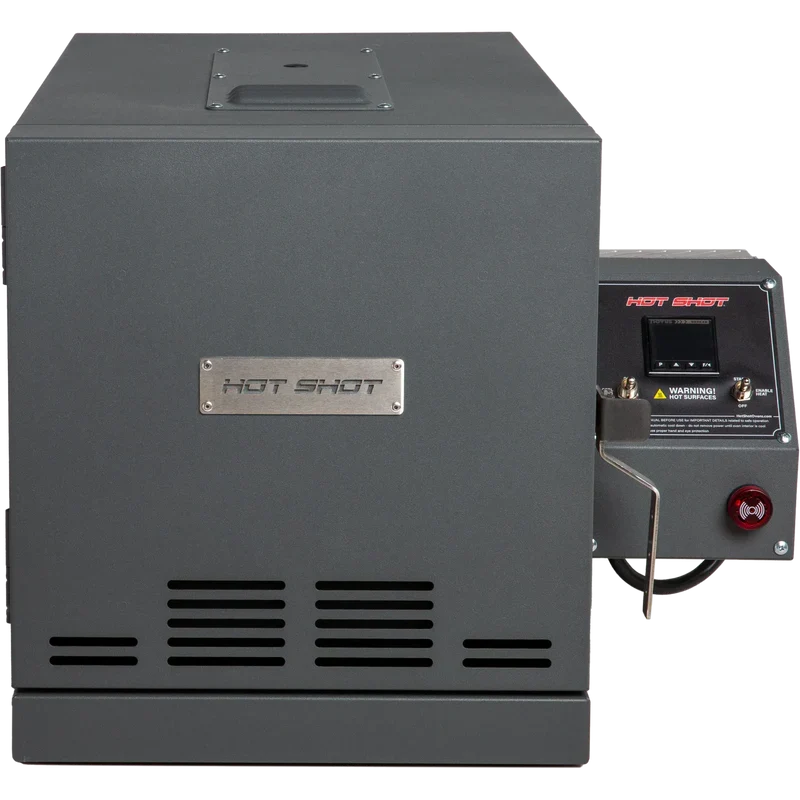
| Hot Shot HS-18K | See product page | See product page | 120V | $2,333.10 |
| Hot Shot HS-1200K | See product page | See product page | 240V | $2,588.25 |
| Paragon KM18 Pro | See product page | See product page | 240V | $4,536.00 |
| Paragon PMT13 | See product page | See product page | 240V | $4,890.38 |
Paragon's and Hot Shot's specifications aren't retrievable the way Evenheat's and Jen-Ken's are, so those cells say so rather than guess. Ask us and we'll read the figure off the manual before you order.
The comparison worth making twice
The KO 18 reaches 2,350°F and costs $2,729.99. The LB 18 reaches 2,200°F and costs $2,696.39. Thirty-two dollars apart. The trade is chamber size: the LB's 18 × 10 × 6.25" slot is about 26% more volume than the KO's 18 × 9 × 5.5". At 27" the gap closes further — KO 27 at $3,070.19 against LB 27 at $2,911.99, twelve dollars for 150°F.
You are choosing between chamber room and temperature headroom at the same price, and nothing in either listing tells you that. If every steel you run tops out below 2,000°F, take the roomier LB. If you might run MagnaCut at the top of its range, the KO costs a few dollars and a bit of chamber.
The HT-1 deserves the hardest look. At $3,451.99 it is $852.00 more than the KO 18 and stops 350°F lower. What you pay for is shape: 13.5 × 13 × 13.5" is a box rather than a slot, so it takes fixtures, a rack of blades, and work that isn't long and flat. That is a real reason to buy it. Temperature is not.
Tempering: the step that gets the wrong oven
Most steels here temper between 300°F and 500°F, and any dedicated tempering oven handles that. Two cases break the pattern.
CPM-3V tempers at 1,000–1,050°F, three times, two hours minimum each. That is 500°F above where every other steel in this guide tempers, and it rules out a large share of tempering ovens on the market. The Evenheat LT series reaches 1,200°F and covers 3V with room to spare. A 600°F tempering oven does not, and no amount of soak time makes up the difference.
D2 and A2 have a secondary-hardening region, and you probably shouldn't use it. Böhler's K110 datasheet confirms D2 has a secondary hardness maximum and instructs tempering three times above it. But every numeric table we found shows high-temperature tempering losing hardness in a knife: one distributor sheet drops from 58 HRC at 900°F to 55 at 1,000°F, and Thomas found a 950°F temper gave less hardness and less toughness than 400–500°F. If someone sells you a high-temperature oven on the strength of D2 secondary hardening, ask what hardness they expect you to land on.
The stainless grades run the opposite way. AEB-L, Nitro-V and 14C28N should not be tempered at or above roughly 800°F, and Alleima states that tempering 14C28N above 840°F costs both toughness and corrosion resistance. A high ceiling is no use here. Control at 350°F is.
Forge or oven, honestly
A forge can heat-treat 1084 credibly. Thomas's forge trials matched furnace results on hardness and toughness for simple carbon steels, because those steels quench fully from just past non-magnetic and the magnet tells you when you're there. 80CrV2 works too, with a caveat: it wants a hotter normalize, around 1,600–1,650°F.
Above roughly 3% chromium the magnet stops being useful. That 3% figure is Thomas's own experimental finding rather than a mill specification, so treat it as a rule of thumb — but it lines up with where the recipes start asking for things a forge cannot deliver. A2 needs a held pre-heat and a timed 30-minute soak. Nitro-V needs 5 to 10 minutes and no more. 14C28N needs five minutes at 1,922°F, then 1,112°F within two minutes. Those aren't temperatures you can eyeball; they are intervals you have to measure, which means a controller and a thermocouple.
The dividing line is about time, not heat.
Which should you buy
You forge 1084 and 80CrV2 and want to stop guessing. The Jen-Ken Vertical Air Bath 16 at $1,736.00 is the cheapest controlled oven in our range and its 2,200°F ceiling is more than those steels will ever need. Every Jen-Ken is built to order, so plan for lead time.
You want one oven that handles anything you're likely to buy. The Evenheat KO 18 at $2,729.99. At 2,350°F nothing in this guide is out of reach, including MagnaCut at the top of its range, and it costs what the 2,200°F LB 18 costs. The 18 × 9 × 5.5" chamber takes a hunting knife comfortably; measure first if you make long blades.
You make long blades. The Evenheat LB 27 at $3,057.59 gives 27" of depth at 2,200°F; the KO 27 gives the same depth at 2,350°F for twelve dollars more. Past 27" the KF Extreme series runs to 49.5", still at 2,200°F, and the price jumps — $4,796.00 at 31.5". Depth is the expensive dimension.
You're on 120V and can't add a circuit. The Evenheat KH 414 at $2,763.59 reaches 2,200°F on 120V, 13A. The 13.5 × 6.5 × 4.25" chamber is small, and that is the trade. Before assuming you need 120V, read Kiln Electrical Requirements — a 240V circuit is often cheaper than a compromised oven. Our 120V kiln guide covers the plug-in range more broadly.
You heat-treat and temper in one oven and it's costing you days. A separate LT 18 at $2,809.79 frees the main oven while two-hour tempers run, and its 1,200°F ceiling covers CPM-3V. If you never touch 3V or D2, a cheaper low-temperature oven does the job — ask us rather than over-buying ceiling.
Where each brand is weaker
We sell all of them, so here is the unflattering column. For how the same brands compare on pottery kilns, see Olympic vs Paragon vs Evenheat.
- Evenheat publishes the most complete specifications of any brand we carry. But the HT series at 2,000°F is its lowest ceiling at its highest price per degree, the LB and KF lines stop at 2,200°F, and Evenheat never specifies a thermocouple type, only "special limits".
- Paragon reaches 2,350°F across the KM and PMT lines, and its Double Barrel design is the only two-chamber oven here: one bore holds an austenitizing temperature while the other holds a temper. Documentation is the weak point, since Paragon's site blocks automated spec retrieval and every figure has to be read off a page or manual by hand.
- Hot Shot is the cheapest way into a controlled oven, with the HS-18K at $2,333.10. But Hot Shot publishes no temperature ratings on its category pages, which makes model-to-model comparison harder than it should be.
- Jen-Ken is the value end, and the vertical air-bath design suits blades. Every oven is built to order, so there is no quick ship; the range caps at 2,200°F; and Jen-Ken gives a plug type but no breaker size or wire gauge on the knife ovens.
FAQ
What temperature do I heat treat 1095 at?
1,475°F, held a few minutes to about twenty depending on thickness, then quenched in fast oil. The catch with 1095 is hardenability rather than temperature: above about 1/8" thick, oil may not fully harden it and water is the specified quench. Temper 450–600°F for roughly 62 down to 58 HRC.
Can I heat treat stainless steel in a 2,000°F oven?
For AEB-L, Nitro-V and 14C28N, yes on paper: they austenitize between 1,900°F and 1,994°F. But you would be running at or near the oven's ceiling, which leaves nothing for element wear or thermocouple drift. Among the powder grades, CPM S30V and S35VN top out at exactly 2,000°F and MagnaCut's recommended 2,050°F is out of reach. If stainless is the plan, buy 2,200°F.
What is the hottest knife steel to heat treat?
Among the grades most knifemakers actually buy, CPM MagnaCut and CPM Rex M4 both have datasheet ranges running to 2,200°F, which is the highest you are likely to meet. CPM-3V reaches 2,050°F. The widely repeated claim that 3V is the hottest mainstream knife steel is wrong — MagnaCut and M4 go higher.
Do I need cryo, or is a freezer good enough?
For the stainless grades it changes the numbers materially. New Jersey Steel Baron's Nitro-V figures show 64 HRC at a 300°F temper with cryo against 62 without, and the gap widens as you temper hotter: 62 versus 58 at 400°F. Crucible lists liquid nitrogen or dry ice for MagnaCut, and tabulates a −10°F freezer route that works only if the blade goes in immediately after the quench. A household freezer beats nothing and loses to dry ice.
How accurate does a heat-treat oven need to be?
No steel producer publishes an answer. We checked Alleima, Crucible, Uddeholm, Böhler, Carpenter and Latrobe; none specifies a required oven accuracy or uniformity for knife steels. What they specify is timing: five minutes at 1,922°F for 14C28N, 1,112°F within two minutes of the quench, five to ten minutes for Nitro-V. Those are the figures that tell you whether an oven is adequate. Any ±°F number you are quoted came from a catalogue, not a mill.
Can one oven do both hardening and tempering?
Yes, and most people start that way. The cost is throughput rather than quality — two two-hour tempers tie up a 2,350°F oven for most of a day doing work at the very bottom of its range. Paragon's Double Barrel models solve this in one cabinet with two independent chambers; a separate tempering oven solves it with two machines.
Before you order
Pick your steels first, read the right-hand column of the reference table, and buy a ceiling above it rather than level with it. If two ovens look the same on paper, call us — we will read you the manufacturer's own figures, including the ones that never make it onto a product page, rather than let you order on a guess.
Every oven here ships flat-rate freight with liftgate service, so there is no surprise delivery charge at checkout and no expectation that you will wrestle a crated oven off a truck. Freight details are on our shipping page. We price match: find one of these cheaper elsewhere and tell us where. For a quote, a lead time, or a spec we haven't published, get in touch, or browse Knife Making Ovens and Heat Treating Ovens.
Related reading: Best Heat Treat Oven for Knife Making compares the ovens rather than the steels, and Glass Fusing Temperature Guide is the equivalent reference chart for glass.